

You Are Probably Handing The Wrong Things To AI
What to do by hand, what to automate, and the logic that decides this

Shezaar was a B2B marketplace that helped fashion brands get value from the inventory they were least proud of, the past-season runs, the misfits, the returns, by predicting the price each piece could actually sell for. The clever part was the pricing engine. The hard part, the thing the whole company ran on, was getting brands to talk to me.
So for three weeks I ran an automated outreach sequence I had built myself. It wrote and sent cold messages on my behalf while I was doing something else. I personalized every variable I could. The name and the company obviously. But the two that I was proud of were a line pulled from their latest post and a line about something we had in common, the details that are supposed to make a cold message feel handpicked. I sent at least a hundred of them and I got ZERO replies.
Then one afternoon I closed the tool and wrote a single message by hand. It was a little long. It was just me explaining who I was and what Shezaar was actually for, personalized less to the brand than to what I wanted them to understand about me. I sent it to ten brands and left a real comment on each of their posts. By the next morning, four of them had written back.
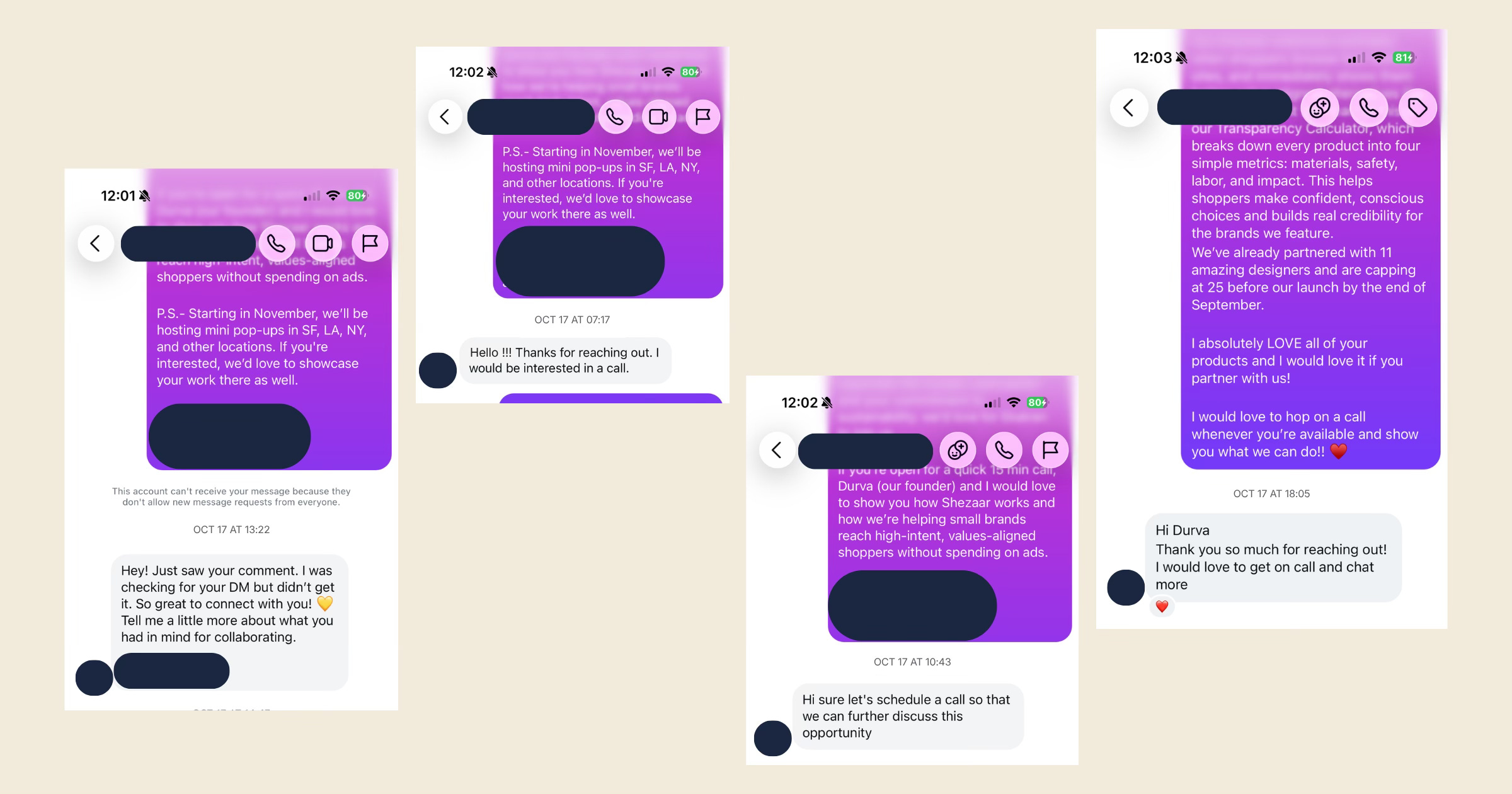
That gap is the whole point of this piece. When you are on your own, automation feels like the sane response to a workload that has no bottom. But what it actually buys you is a wall between yourself and the only people who can tell you the truth about your product.
Why Automation Feels Like Progress
You just shipped an MVP, and the next step, actually talking to customers, is slow and terrifying. Being solo makes it heavier, because every job on the list is your job, and automating all of it can feel like the only way to stay above water. So you reach for AI to fill the silence. I did the same thing.
The appeal is that it looks like motion. You point a tool at a few thousand people, the sent count climbs, and from the outside it reads like reach. What you have actually bought is distance from every single one of them.
The trouble is that at this stage the most valuable thing you own is friction. Every bug report, every confused question, every “I would use this if it did X” is the raw material you need to find the version of the product that actually sells. Automate that layer away too early and you get a quiet inbox and a product that drifts further from anyone who would pay for it.
Where Founders Get It Wrong
Most of the premature automation I see clusters into five moves, and I have made at least three of them myself.
Automating support before you have users. Founders deploy an AI chatbot so they never have to sit in a live conversation with a confused customer. At the MVP stage that conversation is the asset, not the chore. The customer would rather reach a human anyway, and that one unscaled exchange is where relationships are built. You are trading your clearest signal for a reply speed nobody asked for.
Building the pipeline instead of shipping the product. Founders who can code are the worst here. You spend a week building an automated onboarding flow that tags every new signup, drops them into a database, and fires off a welcome sequence, when you have eleven signups you could read by hand in an afternoon. The build feels like progress because it might be hard to do. But you are smoothing a path before you know whether anyone wants to walk down it. And every step you just automated is one more thing you will have to maintain and unpick later, when the product changes!
Blasting automated outreach. I showed you my version of this already. The part I missed at the time is that the personalization was never the problem. A message can carry your name, your company, and a line about your last post and still land as exactly what it is, one cold note out of a thousand. People can smell an AI-written message from a mile away, and the early adopters you most want are the fastest to catch it. What makes someone write back is knowing you picked them on purpose, and a tool working down a list cannot give them that, no matter how “personalized” it feels.
Letting AI write the roadmap. It is easy to paste your early feedback into an LLM and ask what to build next, and what comes back looks orderly and convincing. But a model can only rearrange what is already sitting in the feedback. It will hand you the safe average of what everyone asked for, which ends up being the exact version of your product that competes with everyone else’s. Because remember, most of the times, your customers do not know what they want. The one call no model can make for you is which uncomfortable, specific bet your customers need.
Automating a craft before you have done it once. It is tempting to buy the AI video editor or the AI copywriter before you have made a single video or written a single post by hand. The problem is that you cannot judge what it gives back. If you have never cut a video yourself, you cannot tell whether the automated one is good or just fast, so you ship generic work without ever knowing it is generic. Do it badly by hand at least once. That is what earns you the right to hand it off.
The Rule Of Thumb
The fix is not to swear off automation. It is to automate on a schedule the business earns, not one your anxiety sets. For the customer-facing work, that schedule looks like this.
First 10 customers: Everything by hand. Talk to every user. Write every onboarding email yourself.
Next 50 customers: Automate friction only. Reach for a basic tool when a manual task costs more than five hours a week.
100+ customers: Scale with AI. Automated support, real data pipelines, programmatic growth. Maybe hire someone.
Notice that nothing in the first column is clever. It is supposed to feel slow and unscalable, because that slowness is what keeps you close enough to hear what the product is missing.
For everything else on this list, the roadmap, the outreach, the video edit, the same two questions decide it.
Have you done this by hand enough to recognize a bad result when the tool hands you one?
Is it the biggest thing eating your week right now?
If the answer to either is no, you have not earned the automation yet.
The One Thing To Do This Week
Pick the one task you have automated that sits closest to a customer, your chatbot or your outreach tool, and turn it off for a week. Do that job by hand instead, slowly and a little badly. Watch what comes back.
When I turned mine off, five brands replied in a day after a hundred automated messages had gotten me nothing. The automation was not saving me time. It was charging me the one thing a new product cannot afford to lose, which is contact with the people it was built for.
If this hit a nerve, reply and tell me the one thing you automated too early.

I love this! I believe that by 2027 everyone should have a personal document about their principles for when they do & do not apply AI. It’s increasingly becoming a mandate & skill
Yeah I like the idea of friction as an asset here. and any time I see a number from our company's home page repeated to me in a cold email, I have an allergic reaction.