

Do you have the right base for your AI Agents?
Three pillars I built so my AI agents get smarter with every pass

The very first AI agents I built were not smart, and I found that out when the agent that edits my Substack drafts followed a rule I had already removed weeks earlier and I almost posted it!!
But that does not happen anymore.
Every morning before I open my laptop, three of my minions aka Claude agents already have a stack of finished work waiting for me. One drafts a brief from the Substack articles, podcast episodes, and news that actually interest me. A second tracks everyone I follow and flags what changed about them overnight (a bit stalker, I know!). A third reads my content analytics, tells me what worked and what didn’t, and tells me who is engaging with my content and what I should say to them.
And none of them would break if I add anything on top!
So what changed between the version that broke and the one that hasn’t needed a fix in over a month?
Structure.
The Context
When you bring in AI automation, you are not writing code. You are writing a job description, and the agent is only as good as the information you provide.
Context is the onboarding packet.
An AI that doesn’t know who you are, what your business is, or what you have already tried will eventually get something wrong.
I think of context in two levels. First is the global level. This is context which will be used by every skill. So anything about the business goes in here. Who you are, who your audience is, the strategies you have already tried, what your voice actually sounds like. You get the picture.
Second is the local level. Context that I do not want other skills to touch. For example, I am building the same three-agent setup for Instagram that I have for Substack right now, and I deliberately do not want that agent reading how I write on Substack. The scripts I want on Instagram should not sound anything like a Substack article, so the rhythm rules stay local to the Substack agents only.
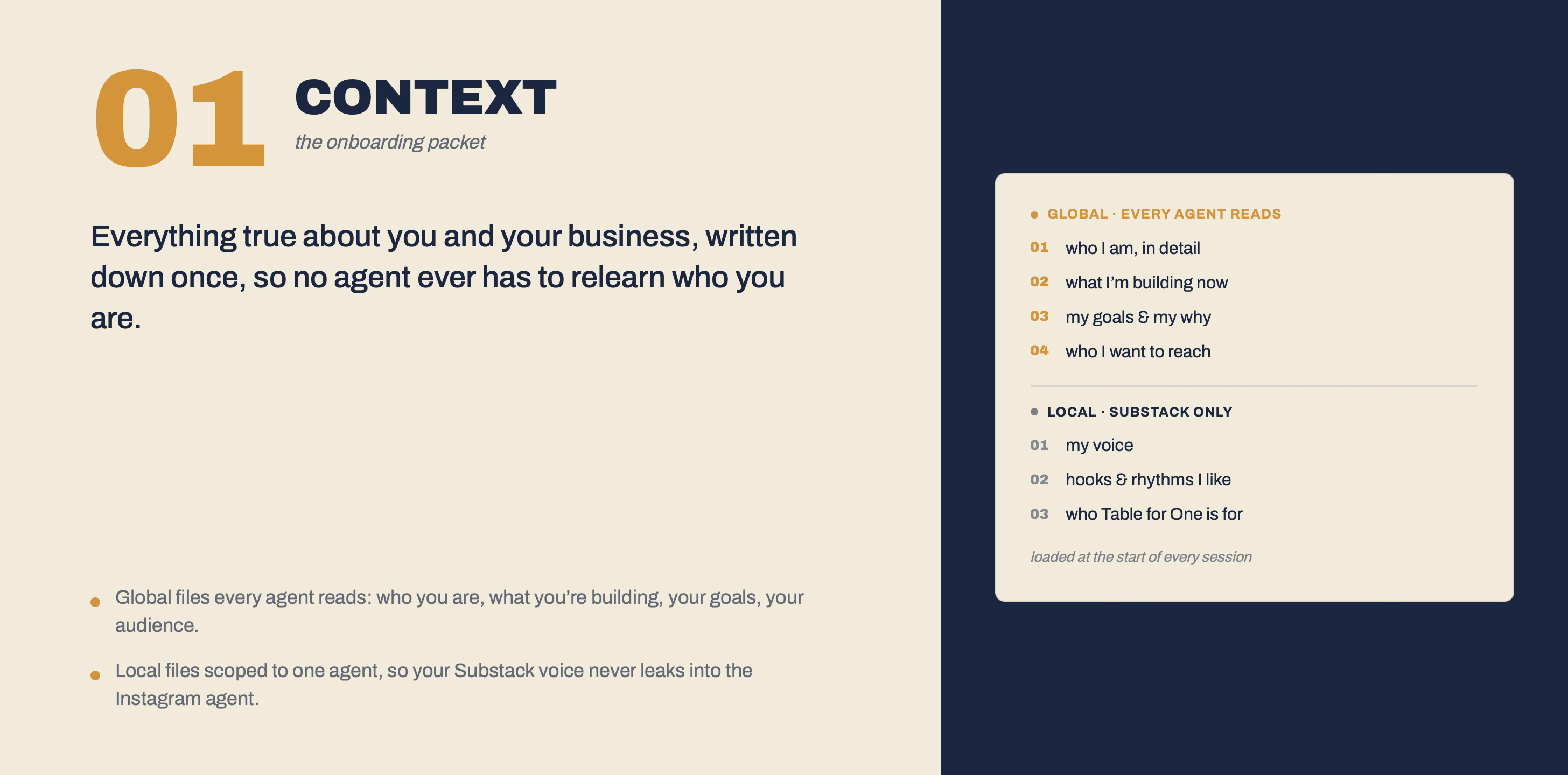
So my global context files are:
Who I am, in excruciating detail. How do I think? What do I like? What do I dislike? Everything.
What I am building right now. Substack, the community, Shezaar, and whatever I will do next. This file has that information.
What are my goals? What are my dreams? My why behind everything I do.
Who do I want to talk to? Who is my target audience?
For Substack specifically, my context folder is three files.
My voice. How I like to write. How I like to talk.
Any hooks and rhythms I like.
Who Table For One is for.
All of these files load automatically at the start of every editing session. There is a lot of trial and error involved in why I have arranged these the way I have, but this structure works the best for me.
That is the whole point of context: the system does not have to relearn who I am every time it runs. But an agent that knows everything about me and my business can still do something I never signed off on. So next I need a set of rules.
The Guardrails
If context is the onboarding packet, guardrails are the job description.
I prefer to keep all the rules for one agent in a single folder inside the agent folder. And the job of the skill.md file is to make sure that my agent reads the rules.
