

B for Bias: The story you're telling yourself about your customer
Why founders confuse the customer they want for the customer they have.

Before we get into it, I want to prove that you are biased. So, humor me.
There are four cards on a table. Each card has a letter on one side and a number on the other. The four cards showing are:
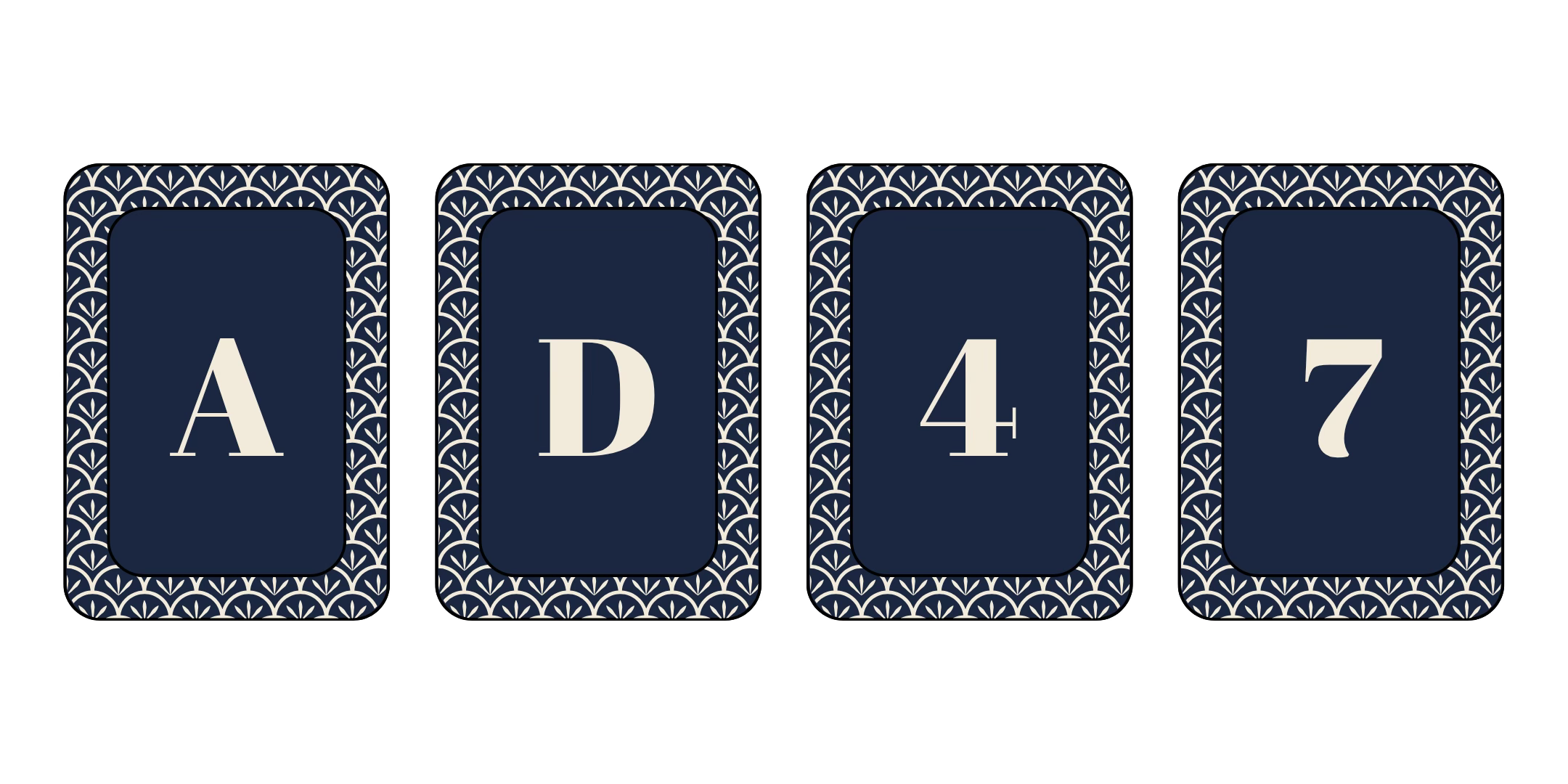
Here’s the rule: If a card has a vowel on one side, then it has an even number on the other side.
Task: Which card or cards do you need to flip over to check whether the rule is true or false? (You can flip at max 2 cards.)
→ Click here to play the game or scroll to the bottom of this post for the solution.
I can guarantee one thing. Most people will get this wrong. And the reason for it is what nearly killed my startup.
Building In An Echo Chamber
When I started building Shezaar, I needed to validate the idea. So I did what every founder is told to do: I talked to people.
The problem is who I talked to.
I reached out to people who were already conscious consumers. Sustainability managers at brands. Employees in CleanTech firms. People who were already deeply invested in the idea that fashion generates waste and that has to stop. Every single one of them told me, yes, this is a huge issue. Yes, we need a better solution.
But I didn’t ask the hard questions that would disprove my theory. I didn’t wait to confirm whether they had already found a patchworked solution.
On the brands side, I spoke to founders at sustainable fashion brands who were already building solutions to reduce waste. I never talked to brands who didn’t care about sustainability. The brands for whom taking the loss on markdowns wasn’t a big deal.
So every conversation, I walked away feeling validated. I had “done my research.” I had “talked to the market.” But what I had actually done was test my hypothesis by only talking to people who would say yes.
That cost me months.
This is called confirmation bias. The tendency to seek out information that supports what you already think and ignore information that challenges it.
More Delusion Than Required
Being slightly delusional as a founder is required. But there is such a thing as too much delusion.
When I was talking to my early users, fellow founders, advisors, investors, a lot of people warned me about the say-do gap in sustainable fashion. Consumers say they care about sustainability. They say they’ll pay more for it. And then they don’t.
I saw the research, I spoke to the people that failed, basically I heard it all. And I thought: that’s a real problem, but it won’t apply to what I’m building. I tried to actively prove to myself why I would have a different outcome.
Then the platform launched and reality showed up. The people who told me they'd use it didn't use it the way I expected. The engagement patterns I projected didn't materialize. The urgency I assumed consumers would feel about a better way to buy past-season inventory simply wasn't there.
That cost me money.
This is optimism bias. The belief that negative outcomes that happen to other people won't happen to you. Not because you have evidence, but because you are optimistic.
The Struggle To Let Go
Conviction is an absolute must as a founder. But choosing to ignore the signals in the name of conviction is what kills companies.
I spent months building an MVP for the consumer side of Shezaar. A platform where conscious consumers could discover and purchase past-season inventory from brands that would otherwise discard it. The interface, the user flows, the brand onboarding process. All of it designed for a B2C model.
Then the signals started coming in that B2B was the better path. Brands didn’t want another consumer-facing channel. And consumers did not want another platform. The data pointed toward B2B. The conversations pointed toward B2B. The logic pointed toward B2B.
But I couldn’t let go of what I’d already built. So I doubled down. More time, more iteration, more patience, more marketing.
It didn’t need more time. It needed to be abandoned. And every week I spent doubling down was a week I wasn’t spending on the thing that might have actually worked.
This is the sunk cost fallacy. The more you've invested in something, the harder it becomes to walk away, even when walking away is clearly the right move.
Who Checks Your Biases If You Are The Only One In The Room?
In a co-founding team, your biases get challenged because someone else is looking at the same data and asking different questions. Solo founders don’t have that. Every assumption gets a free pass unless you deliberately build a system to challenge it. And biases don’t just go unchecked. They compound. One bad assumption feeds the next, and by the time you realize it, you’ve been building in the wrong direction for months.
A Harvard Business School study found that the same cognitive biases that give founders early advantages (optimism that lets you start, conviction that lets you persist) become serious liabilities when they go unchallenged. And introducing even one structured “devil’s advocate” can cut decision-making errors significantly.
The best founders aren’t the ones without bias. They’re the ones who’ve learned to assume it’s always there.
The Bias Check
I haven't figured out how to be unbiased all the time. But I have a system that helps me keep it in check.
Step 1: Write Down Your Biases
You can't fight what you can't see. Before any major decision, ask yourself three questions:
Am I testing this, or am I confirming it? If every conversation, every data point, every piece of feedback agrees with you, that's not validation. That's an echo chamber. Figure out who you have not talked to. What would the person who thinks this is a terrible idea say? Seek those people out.
What would have to be true for this to fail? Not "could this fail?" but "what specific thing would make this not work?" Be concrete.
What have I already invested that’s making it hard to walk away? Name it out loud. Time. Money. Code. Ego. The version of yourself you’ve been telling people about. When you can name the sunk cost, it loses some of its grip on you. Not all of it. But some.
Step 2: Find A Devil's Advocate
Build one relationship where the explicit job is to disagree with you. Not a cheerleader. Someone who challenges you. Tell them: "Your job is to argue with me. If I sound too confident, push back. If I only have confirming evidence, point that out." This is the closest a solo founder gets to the natural friction a co-founder provides.
Step 3: Reframe Your Questions
Based on your answers from Step 1, frame your discovery questions to challenge your biases. Make them as open-ended as possible. Not "Do you think this is a good idea?" but "What would stop you from using this?" Not "Would you pay for this?" but "Walk me through how you currently solve this problem and what you spend on it." The goal is to design questions that make it easy for someone to tell you something you don't want to hear.
The Answer To The Card Puzzle
The correct cards to flip are A and 7. Only about 10% of people get this right.
Why A? It’s a vowel. The rule says vowels must have even numbers on the back. You need to check.
Why 7? This is the one most people miss. If there’s a vowel on the back of 7 (an odd number), the rule is broken. You have to look for what would disprove the rule, not just confirm it.
Why not D? The rule says nothing about consonants. Whatever’s on the back doesn’t matter.
Why not 4? This is the most common mistake. People flip 4 because it “matches” the rule. But the rule doesn’t say “all even numbers must have vowels on the back.” A consonant behind the 4 wouldn’t break anything.
Most people pick A and 4. They look for evidence that supports the rule. Almost no one picks 7, the card that could actually break it.
That’s confirmation bias. We look for proof that we’re right. We almost never look for proof that we’re wrong.
Your brain wants to be right. As a founder, your job is to want to be wrong. Or at least, to be willing to find out.
This is part of the A to Z of Building Solo. 26 lessons from my experience as a solo, non-technical founder. No playbooks. No borrowed wisdom. Just what I learned the hard way building Shezaar. New letters drop every Friday.